The Battle belongs to the Lord

The Battle belongs to the Lord
“But I say to you, do not resist an evil person; but whoever slaps you on your right cheek, turn the other to him also.” NASB1995
(See notes below taken from Bibleref.com)
The Sermon on the Mount, which began early in chapter 5, contains difficult concepts for human nature to accept. Jesus is setting a seemingly impossible standard for those who would enter the kingdom of heaven (Matthew 5:20). Refusing to murder is not enough: don’t even insult another in anger (Matthew 5:21–22). Not committing adultery is not enough: don’t even intentionally lust (Matthew 5:27–28). His larger point is that none are righteous enough to enter heaven, based on their own good deeds (Matthew 5:48). Everyone, no matter how “holy” they may seem, must receive forgiveness of sins and righteousness through faith in Christ.
This verse is often badly misunderstood, due to two ideas that are less common today: lex talionis and the idea of being slapped on the cheek.
In the prior verse (Matthew 5:38), Jesus referred to a rule in the Old Testament (Deuteronomy 19:21) called the lex talionis, often summarized as “eye for an eye.” After thousands of years of Christian influence, and in fact because of that influence, modern people often think this as a cruel standard. In truth, God established this to limit violence and revenge. The point of “eye for an eye” was that punishment is to be proportional to the crime, rather than an ever-escalating cycle of revenge.
Jesus does not dispute the legal aspects of “eye for an eye,” so far as they apply to a courtroom or the government. But in personal terms, He sets a much more challenging standard. Limiting revenge is not God’s intent for the hearts of His people. Refusing revenge is God’s will and Jesus’ command to His followers (Romans 12:19). This does not mean Christians cannot flee, nor does it mean that blatant violence and evil should be met with total pacifism (Luke 22:36). It does mean that so far as we’re able, Christians are not to “return evil for evil” (Romans 12:20–21).
This is consistent with Jesus’ comments about turning the other cheek. In the ancient world, the right hand was always assumed to be dominant. Jesus specifically refers to the “right cheek,” here.” That implies a backhanded movement: to slap someone on the right cheek, with the right hand, is more intimidation and abuse than mayhem. Even in the modern world, the term “slap in the face” is used in reference to insults and slights. To “turn the other cheek” implies taking that insult and accepting that another might be on the way.
In short, Christ’s command here does not mean “you must do nothing while someone beats you into a bloody pulp.” He is speaking to believers who will experience persecution and hate from the world (Matthew 5:11–12). The proper Christian response to discrimination, mocking, or insults is to simply let it go: “don’t resist the evil person.” Instead, prove that such acts are not worth a response. Even better, as the following verses show, is to turn abuse upside down through love (Matthew 5:40–42).
In this book, Nahum portrays the downfall of Nineveh and Assyria as an image of how God will confront and bring down all violent human empires.


from John MacArthur study Bible
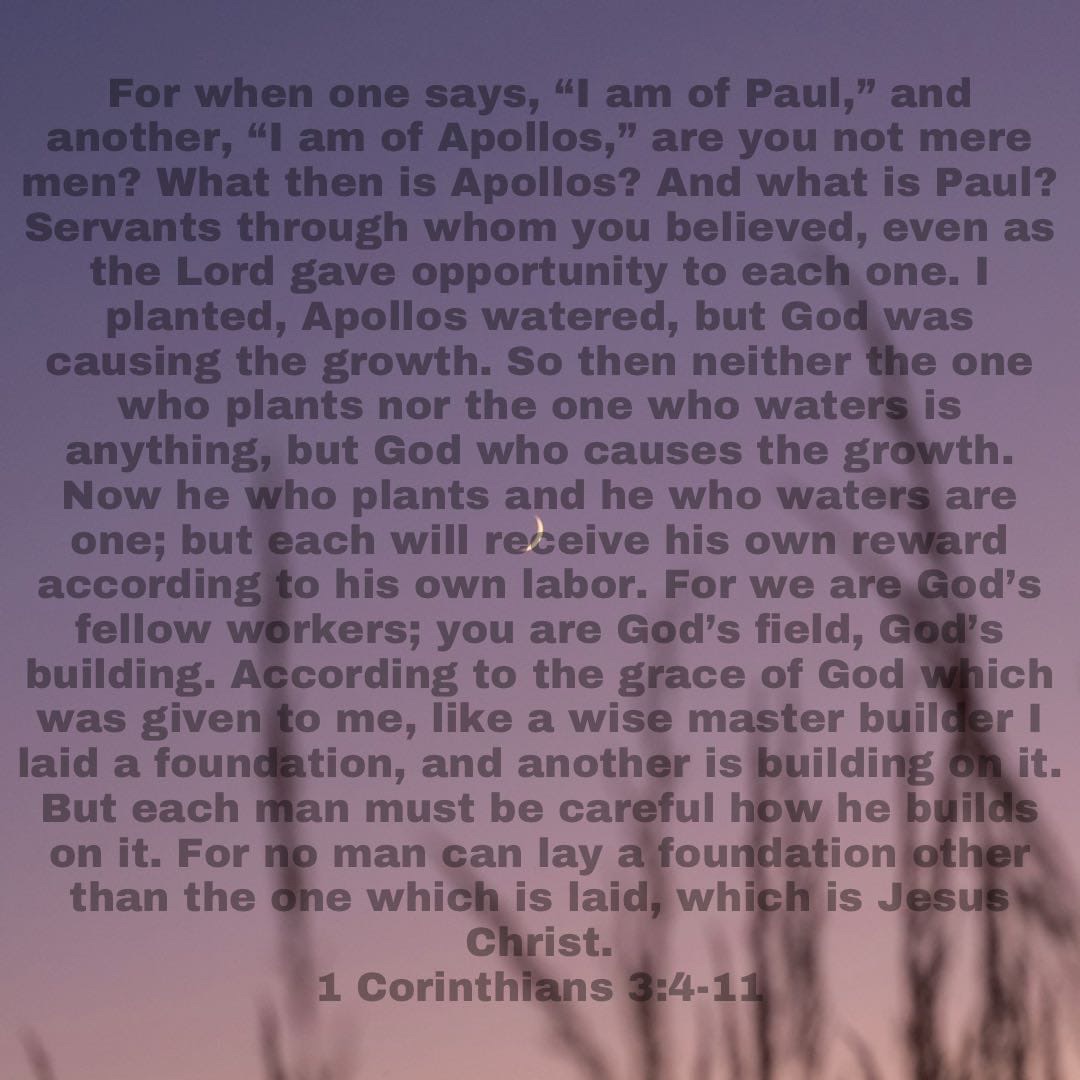
3:4 Paul … Apollos. Factionalism was the divisive product of carnality. Cf. 1:11–13. †
3:5–7 What then is Apollos … Paul? A humble, but accurate assessment of the roles that ministers play. the Lord gave … God who causes the growth. It is the Lord alone who can give the faith to the spiritually ignorant and dead. Salvation is God’s work of grace to whom He chooses to give it (see notes on Ro 9:15–19; Eph 2:8, 9).
3:8 are one. All the human instruments God uses to produce salvation life are equally considered and rewarded for their willingness to be used by God. But all the glory goes to Him, who alone saves. Because of that, the silly favoritism of v. 4; 1:12 is condemned. See notes on Mt 20:1–16.
3:9 we. Paul, Apollos, Peter, and all ministers are equal workers in the field, but the spiritual life from that field is entirely by God’s grace and power. God’s building. Paul shifts the imagery from agricultural to construction (vv. 10–17). †
3:10 master builder … foundation. The Gr. word is the root for architect, but contained the idea of builder as well as designer. Paul’s specialty was designing and building spiritual foundations (cf. Ro 15:20). He was used by God to establish the groundwork for churches in Asia Minor, Macedonia, and Greece. Others (e.g., Timothy, Apollos) built the churches up from his foundations. That God used him in that way was all of grace (cf. v. 7; 15:20; Ro 15:18; Eph 3:7, 8; Col 1:29). each man. This primarily refers to evangelists and pastor-teachers.
3:11 no … foundation other than. Paul did not design the foundation, he only laid it down by preaching Christ. Cf. 1Pe 2:6–8.