
Tag: Messiah
 www.bible.com/100/psa.9.1.nasb1995
You are the strength when I am weak, you are the treasure that I seek, you are my all in all.
 www.bible.com/100/nam.1.7.nasb1995
The painful truth, yet joyful reality, that God loved us so much, to give Jesus as an offering for our wicked hearts, that whomever would believe in him, would live, just as Jesus would live again, as he rose from the grave, and conquered death.
 www.bible.com/100/jhn.3.14-15.nasb1995
This is a veiled prediction of Jesus’ death on the cross. Jesus referred to the story of Nu 21:5–9 where the Israelite people who looked at the serpent lifted up by Moses were healed. The point of this illustration or analogy is in the “lifted up.” Just as Moses lifted up the snake on the pole so that all who looked upon it might live physically, those who look to Christ, who was “lifted up” on the cross, will live spiritually and eternally.

It is our HEART, that the Lord is interested in, not checking off a box, that WE did something right before him. When we humbly bow down before him, he lifts us up! It is him who must work through us, not We, ourselves. Thank you Jesus, that you gave us your helper, your Holy Spirit, and your word, to guide and direct us. ❤️
 www.bible.com/100/pro.21.3.nasb1995
Salvation is free to all who come and drink from the water. The price that was paid was costly, but for those that come, they are freed from the bondage, of all that weighs them down in this fallen world. The message is simple, come. Please come? Don’t wait to the open invitation……….COME!
 www.bible.com/100/isa.55.1-2.nasb1995
Our slate is wiped clean, there is no memories of wrongs committed, we are free from the bondage of sin, our canvas is empty to start new! Jesus has taken the judgement off our backs for the wrongs done. Do we Believe this? Then let’s start this year with hope, for a new tomorrow, both now, and for all eternity. God is still on the Throne.
 www.bible.com/100/2co.5.17.nasb1995
He came that we might have life. Merry Christmas everyone. Jesus has brought, “Joy to the World”!
 www.bible.com/100/jhn.1.14.nasb1995
He will Rescue us from Ourselves. This is Cause for much Celebration as we Remember !
 www.bible.com/100/mat.1.21.nasb1995
A Great Way to be Reminded, of this Season we Celebrate.
 www.bible.com/114/luk.1.37.nkjv
The King finally will Arrive in Human Flesh. A Promised Savior. A Rescuer of the Poor in Spirit.
Hallelujah, the first coming of Jesus, to set men free from the bondage of sin, to those who BELIEVE. Oh what a gift, that is the Perfect Gift, for all time!
Thank you Father, for sending the Son, that We might have eternal life, and inheritance of being called Sons and Daughters of God!
We Are Blessed, beyond All Measure!!!
Can I get an AMEN???

God chooses the last prophet to prepare the way for the coming Messiah! (Too much to put here. See notes below).
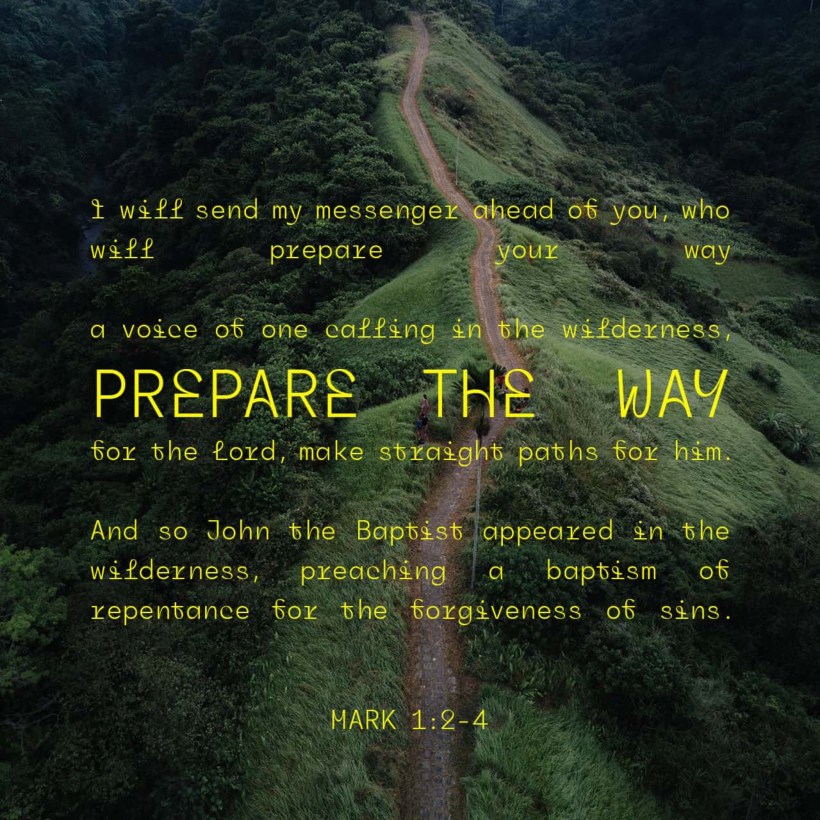 www.bible.com/114/mrk.1.2-4.nkjv
Notes from John MacArthur Study Bible.
1:2 it is written. A phrase commonly used in the NT to introduce OT quotes (cf. 7:6 ; 9:13 ; 14:21 , 27 ; Mt 2:5 ; 4:4 , 6 , 7 ; Lk 2:23 ; 3:4 ; Jn 6:45 ; 12:14 ; Ac 1:20 ; 7:42 ; Ro 3:4 ; 8:36 ; 1Co 1:31 ; 9:9 ; 2Co 8:15 ; 9:9 ; Gal 3:10 ; 4:22 ; Heb 10:7 ; 1Pe 1:16 ). in Isaiah the prophet. Mark’s quote is actually from two OT passages ( Is 40:3 ; Mal 3:1 ), which probably explains the reading “the Prophets” found in some manuscripts. The gospels all introduce John the Baptist’s ministry byquoting Is 40:3 (cf. Mt 3:3 ; Lk 3:4 ; Jn 1:23 ). M Y MESSENGER . John was the divinely-promised messenger, sent to prepare the way for the Messiah. In ancient times, a king’s envoys would travel ahead of him, making sure the roads were safe and fit for him totravel on, as well as announcing his arrival. † 1:4 John. A common Jewish name in NT times, it is the Gr. equivalent of the Heb. name “Johanan” (cf. 2Ki 25:23 ; 1Ch 3:15 ; Jer 40:8 ), meaning “the Lord is gracious.” John’s name was given by the angel Gabriel to hisfather Zacharias, during his time of priestly service in the temple ( Lk 1:13 ). His mother, Elizabeth, also a descendant of Aaron ( Lk 1:5 ), was a relative of Mary the mother of Jesus ( Lk 1:36 ). As the last OT prophet and the divinely ordained forerunner of the Messiah ( see note on v. 2 ), John wasthe culmination of OT history and prophecy ( Lk 16:16 ) as well as the beginning of the historical record of the gospel of Jesus Christ. Not surprisingly, Jesus designated John as the greatest man who had lived until his time ( Mt 11:11 ). baptism. Being the distinctivemark of John’s ministry, his baptism differed from the ritual Jewish washings in that it was a one-time act. The Jews performed a similar one-time washing of Gentile proselytes, symbolizing their embracing of the true faith. That Jews would participate insuch a rite was a startling admission that they, although members of God’s covenant people, needed to come to God through repentance and faith just like Gentiles. in the wilderness. The desolate, arid region between Jerusalem and the Dead Sea ( see note on Mt 3:1baptism of repentance. A baptism resulting from true repentance. John’s ministry was to call Israel to repentance in preparation for the coming of Messiah. Baptism did not produce repentance, but was its result (cf. Mt 3:7 , 8 ). Far more than a mere change of mind orremorse, repentance involves a turning from sin to God (cf. 1Th 1:9 ), which results in righteous living. Genuine repentance is a work of God in the human heart ( Ac 11:18 ). For a discussion of the nature of repentance, see notes on 2Co 7:9–12 . for theforgiveness of sins. John’s rite of baptism did not produce forgiveness of sin ( see notes on Ac 2:38 ; 22:16 ); it was only the outward confession and illustration of the true repentance that results in forgiveness (cf. Lk 24:47 ; Ac 3:19 ; 5:31 ; 2Co 7:10
 Living Waters