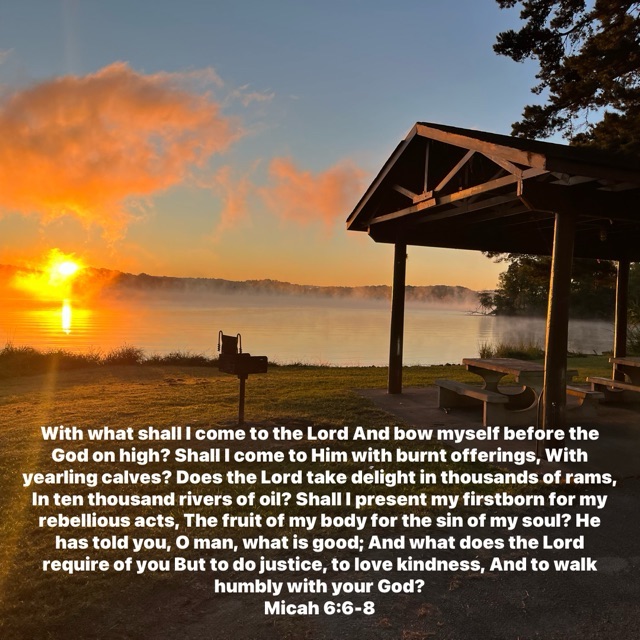
3–5 This was the Lord’s appeal. With tenderness and emotion, the divine Plaintiff recalled His many gracious acts toward them, almost to the point of assuming the tone of a defendant. Noting their trek from bondage in Egypt to their own homeland, God had provided leadership (v. 4), reversed the attempts of Balaam to curse the people (v. 5a; cf. Nu 22–24), and miraculously parted the Jordan River (v. 5b) so they could cross over from Shittim, located E of the Jordan, to Gilgal on the W side near Jericho. God had faithfully kept all His promises to them. † 6:6, 7 Micah, as though speaking on behalf of the people, asked rhetorically how, in light of God’s faithfulness toward them, they could continue their hypocrisy by being outwardly religious but inwardly sinful. † 6:8 Micah’s terse response ( v. 8) indicated they should have known the answer to the rhetorical question. Spiritual blindness had led them to offer everything except the one thing He wanted—a spiritual commitment of the heart from which right behavior would ensue (cf. Dt 10:12–19; Mt 22:37–39). This theme is often represented in the OT (cf. 1Sa 15:22; Is 1:11–20; Jer 7:21–23; Hos 6:6; Am 5:15).

 bible.com/bible/100/nam.1.7.NASB1995
 bible.com/bible/100/isa.60.1.NASB1995
 bible.com/bible/100/isa.43.18-19.NASB1995
 bible.com/bible/59/1jn.4.18.ESV
 www.bible.com/100/mic.6.8.nasb
 www.bible.com/100/rom.6.23.nasb
 www.bible.com/100/1jn.4.18.nasb

 Living Waters