A light to the World, to open our eyes to our own darkness, to remove the chains of bondage. Our part……..Believe and walk in faith in Jesus, who did what we could not.
“I am the Lord, I have called You in righteousness, I will also hold You by the hand and watch over You, And I will appoint You as a covenant to the people, As a light to the nations, To open blind eyes, To bring out prisoners from the dungeon And those who dwell in darkness from the prison.”
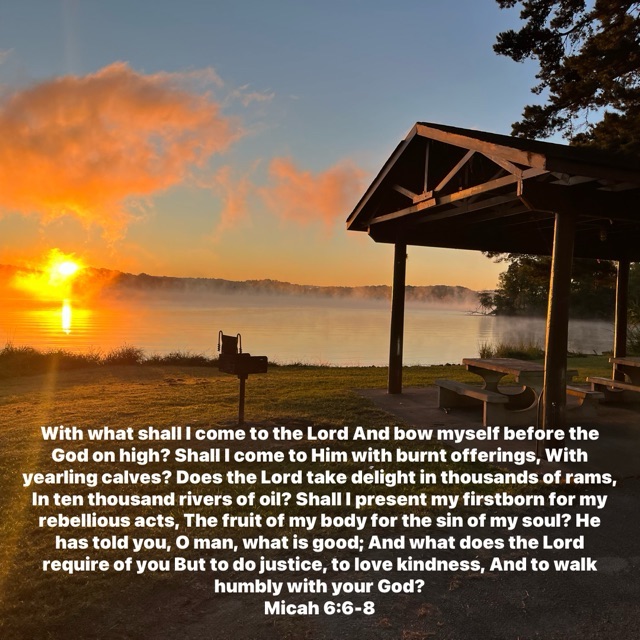
3–5 This was the Lord’s appeal. With tenderness and emotion, the divine Plaintiff recalled His many gracious acts toward them, almost to the point of assuming the tone of a defendant. Noting their trek from bondage in Egypt to their own homeland, God had provided leadership (v. 4), reversed the attempts of Balaam to curse the people (v. 5a; cf. Nu 22–24), and miraculously parted the Jordan River (v. 5b) so they could cross over from Shittim, located E of the Jordan, to Gilgal on the W side near Jericho. God had faithfully kept all His promises to them. † 6:6, 7 Micah, as though speaking on behalf of the people, asked rhetorically how, in light of God’s faithfulness toward them, they could continue their hypocrisy by being outwardly religious but inwardly sinful. † 6:8 Micah’s terse response ( v. 8) indicated they should have known the answer to the rhetorical question. Spiritual blindness had led them to offer everything except the one thing He wanted—a spiritual commitment of the heart from which right behavior would ensue (cf. Dt 10:12–19; Mt 22:37–39). This theme is often represented in the OT (cf. 1Sa 15:22; Is 1:11–20; Jer 7:21–23; Hos 6:6; Am 5:15).
1–6 This wisdom psalm basically functions as an introduction to the entire book of Psalms. Its theme is as big as the whole Bible because it tells of people, paths, and ultimate destinations (for a significant parallel see Jer 17:5–8). By two cycles of contrast, Ps 1 separates all people into their respective spiritual categories:
I. By observation, all people are separated ethically (1:1–4)
A. A Picture of the Godly (1:1–3)
B. A Picture of the Ungodly (1:4)
II. By outcome, all people are separated judicially (1:5, 6)
A. The Failure of Ungodly People (1:5)
B. The Fruition of Lifestyles (1:6)
1. Recognition of the godly (1:6a)
2. Ruination of the ungodly (1:6b) ‡
1:1 blessed. From the perspective of the individual, this is a deep-seated joy and contentment in God; from the perspective of the believing community, it refers to redemptive favor (cf. the blessings and cursings of Dt 27:11–28:6). not walk … Nor stand … Nor sit. The “beatitude” man (cf. Mt 5:3–11) is first described as one who avoids such associations as these which exemplify sin’s sequential downward drag. †
1:2 his delight … in the law. Switching to a positive description, the spiritually “happy” man is characterized by the consistent contemplation and internalization of God’s Word for ethical direction and obedience. †
1:3 like a tree. Because of the mostly arid terrain of Israel, a lush tree served as a fitting symbol of blessing in the OT. planted. Lit. “transplanted.” Trees do not plant themselves; neither do sinful people transport themselves into God’s kingdom. Salvation is His marvelous work of grace (cf. Is 61:3; Mt 15:13). Yet, there is genuine responsibility in appropriating the abundant resources of God (cf. Jer 17:8), which lead to eventual productivity. †
1:4 The wicked are not so. This is an abrupt contrast, lit. “Not so the wicked!” chaff. A frequent OT word picture from harvest time for what is unsubstantial, without value, and worthy only to be discarded. †
1:5 Therefore … not stand. “Therefore” introduces the strong conclusion that the ungodly will not be approved by God’s judgment. †
1:6 the LORD knows. This is far more than recognition; the Lord “knows” everything. In this context, the reference is to personal intimacy and involvement with His righteous ones (contra. Mt 7:23; cf. 2Ti 2:19). the way of. The repetition of this phrase picks up on the “path” imagery so characteristic of this psalm. It refers to one’s total course of life, i.e., lifestyle. Here these two courses arrive at the ways of life and death, as in Dt 30:19; Jer 21:8; cf. Mt 7:13, 14. will perish. One day the wicked person’s way will end in ruin; a new order is coming and it will be a righteous order. So Ps 1 begins with the “blessed” and ends with those who “perish” (cf. Pss 9:5, 6; 112:10).
Watch our overview video on the book of Psalms, which breaks down the literary design of the book and its flow of thought. The book of Psalms has been designed to be the prayer book of God’s people as they wait for the Messiah and his coming kingdom.









 Living Waters